
Écrit en 1998 - anglais
Présentation
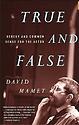
To hell with Stanislavsky. To hell with the Method. "The actor is onstage to communicate the play to the audience," says David Mamet. "That is the beginning and the end of his and her job. To do so the actor needs a strong voice, superb diction, a supple, well-proportioned body and a rudimentary understanding of the play." Anything else"becoming" one's part, "feeling" the character's emotionsdevalues the practice of a noble craft and is useless to the play. "The 'work' you do 'on the script' will make no difference," he cautions. "That work has already been done by a person with a different job title than yours. That person is the author." But True and False does not confine itself to the work done on the actual stage. Its brief essays contain sound advice on how an actor might apply himself or herself to the life of the actor: the proper consideration due the audition process, the selection of parts that one accepts, and so on. Mamet delivers these kernels of wisdom in the taut, no-nonsense prose for which he is justifiably famous, and, ultimately, his core principles are applicable beyond the theater. "Speak up, speak clearly, open yourself out, relax your body, find a simple objective," he instructs. "Practice in these goals is practice in respect for the audience, and without respect for the audience, there is no respect for the theater; there is only self-absorption." Substitute "others" for "the audience" and "life" for "the theater," and could any Taoist say it better?
Autorisation de traduction
Toute traduction pour un usage non privé est strictement interdite sans autorisation.
Contactez l'éditeur pour toute demande de traduction